


Uhuru Corporation Launches AI Front Desk Service for Municipalities and Tourism Operators – No FAQ Creation or Operational Changes Required
Leverages Existing Websites and PDFs as AI Knowledge Sources to Deliver 24/7 Multilingual Support
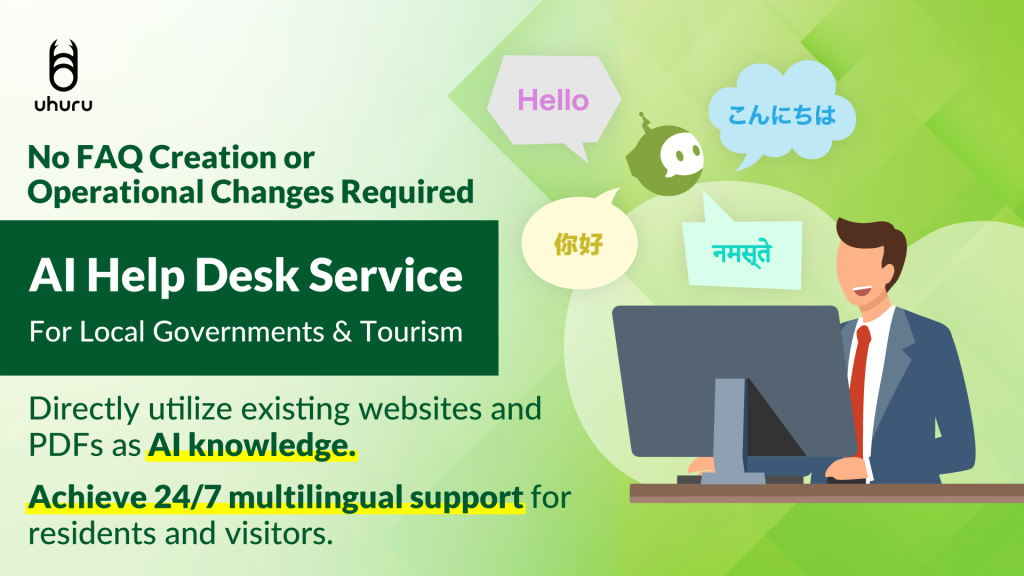
Uhuru Corporation (Head Office: Minato-ku, Tokyo; Takashi Sonoda, President & CEO; hereinafter “Uhuru”) today announced the launch of its AI Front Desk Service, a generative AI chatbot solution designed for municipalities, tourism associations, public facilities, and regional businesses. The service enables organizations to deploy multilingual AI assistance without creating FAQs by utilizing their existing websites and PDF documents as AI knowledge sources.
Background
In recent years, the growing number of inbound tourists to Japan and the increasing number of foreign residents who plan to reside in Japan long-term have accelerated the demand for multilingual information services across municipalities and tourism sectors. At the same time, front desk operations face mounting challenges, including:
・Increased workloads from repetitive, routine inquiries and multilingual support.
・Inconsistencies in response quality among different staff members.
・Information gaps that prevent users from easily receiving the critical updates they need.
In particular, continuously providing guidance on a broad range of topics – such as traffic rules, disaster safety, and administrative procedures – with limited personnel has become a significant operational burden.
Leveraging its experience supporting digital transformation (DX) initiatives for more than 40 municipalities, Uhuru Corporation has launched the AI Front Desk Service to enable organizations to easily implement multilingual generative AI chatbots.
Key Features of the AI Front Desk Service
The AI Front Desk Service is offered as an additional function of Uhuru’s data and service orchestration platform, CUCON. It can also be implemented as a standalone service. By utilizing official websites and PDF documents already maintained by municipalities and organizations, the service automatically builds its AI knowledge base.
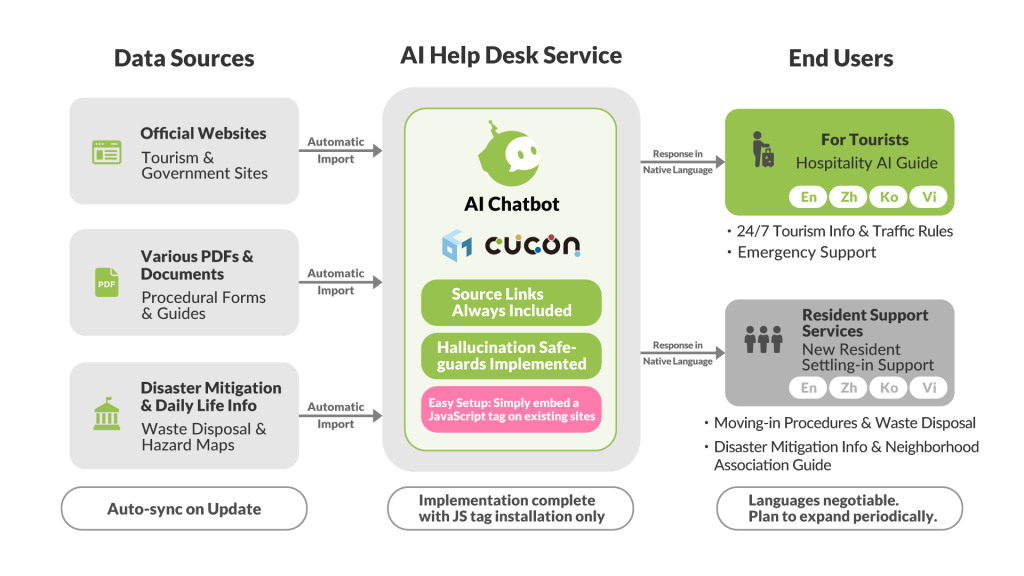
・Seamless Introduction Without Changing Existing Workflows Organizations can deploy the service simply by specifying their existing administrative websites, tourism information pages, and PDF materials. The AI automatically constructs its knowledge base, eliminating the need for manually creating FAQs, which was required in conventional chatbot systems. Operations can begin on the same day of implementation. Furthermore, updates made to websites are automatically reflected in AI responses, ensuring information remains current with minimal maintenance effort.
・Reliable Responses Based Only on Verified Information The AI generates responses using a RAG (Retrieval-Augmented Generation) architecture that references only designated official and administrative information sources. Each response includes source links, providing residents and visitors with direct access to official source materials for full transparency and traceability. By preventing the AI from generating responses based on its own assumptions, the system minimizes the risk of hallucinations.
・Natural Multilingual Communication Powered by Generative AI The generative AI understands conversational context and produces natural responses in users’ native languages. Supported languages include English, Chinese, Korean, and Vietnamese, helping organizations provide seamless information to international tourists and foreign residents.
Primary Use Cases
・Resident Support Services The service provides 24/7 access to essential daily-life information, including residency registration procedures, garbage disposal rules, disaster safety guidance, and local community information. Its multilingual capabilities also assist in acclimating newly arrived foreigners who plan to reside in Japan long-term. Inquiries that frequently arise – such as explanations of neighborhood associations, local customs, and community rules – can be handled efficiently, reducing staff workload.
・Multilingual Assistance for International Tourists and Visitors The service provides multilingual guidance on topics such as cycling tourism traffic regulations (including bans on riding double and helmet requirements), emergency response procedures, and local facility information. By addressing Japan-specific rules and region-specific information needs, the service helps ensure safer and more comfortable stays for international visitors.
・Inquiry Support During Off-Hours and Peak Periods By allowing AI to handle inquiries during evenings, holidays, and busy periods, organizations can reduce staff workload while ensuring that residents and visitors can access necessary information at any time.
▷ About the AI Front Desk Service
Through this initiative, Uhuru aims to leverage data and AI technologies to advance information delivery and operational efficiency for municipalities and local communities, contributing to the realization of a sustainable society.
CONTACT
For inquiries and requests please click the CONTACT FORM button.